The global economy enters 2026 shaped by subdued growth, persistent inflation and evolving geopolitical alignments. The International Monetary Fund (IMF) forecasts global gross domestic product growth at 3.1%, a modest rate sustained by household demand in advanced economies and selective monetary easing, yet clouded by high debt burdens, diverging policy trajectories and fragmenting trade regimes. Against this macroeconomic backdrop, there is mounting pressure on financial stability, with vulnerabilities in non-bank intermediation, liquidity mismatches and volatile capital flows amplifying systemic risk and widening global fault lines.
China remains the pivot of the global economic realignment. Its structural slowdown—driven by a deep property-sector overhang, deflationary impulses, demographic contraction and state-led industrial redirection—has broad implications for commodity demand, global trade routes and capital market flows. The continuing US–China decoupling is no longer sectoral—it is structural. From semiconductor bans to competing AI ecosystems, regulatory divergence and data governance disputes, the financial landscape is being re-architected. Japan’s shift from negative interest rates, Korea’s technological ascendancy and India’s growing geopolitical assertiveness all intersect with this realignment, while recent China–Japan maritime tensions add a strategic layer of risk to regional markets.
The Middle East, meanwhile, sees renewed stability. The Gaza conflict has effectively entered a standing resolution phase, recalibrating regional risk premiums. Countries that are part of the Gulf Cooperation Council, particularly Saudi Arabia and the UAE, are experiencing increased confidence and non-oil investment flows, with implications for capital deployment, energy markets and Washington’s fiscal stance in an election year. In Africa and Latin America, sovereign debt pressures and refinancing walls, especially in Nigeria, South Africa, Brazil and Argentina, strain funding conditions. Europe remains constrained by fiscal fragility and inflation persistence, while the US, though buoyed by technology investment, faces higher-for-longer rates and growing political volatility ahead of the 2026 mid-terms.
Financial stability, not just growth, will define the operating climate for banks. With non-bank institutions accounting for over 50% of global financial assets, liquidity mismatches and concentrated credit exposure are intensifying. ESG priorities have largely shifted from vision to regulation, now embedded within supervisory frameworks. Simultaneously, AI presents a dual-edged risk. While offering cost and productivity gains, it risks fuelling asset bubbles, especially in tech-linked equities, amplified by speculative investment flows and the AI arms race between the US and China. These dynamics pose not only operational but systemic market risks. Digital assets have moved beyond experimentation, now forming part of mainstream financial infrastructure—from tokenised deposits and stablecoin regimes in Asia and the Middle East, to central bank digital currency (CBDC) pilots and blockchain-based verification in Europe and Africa.
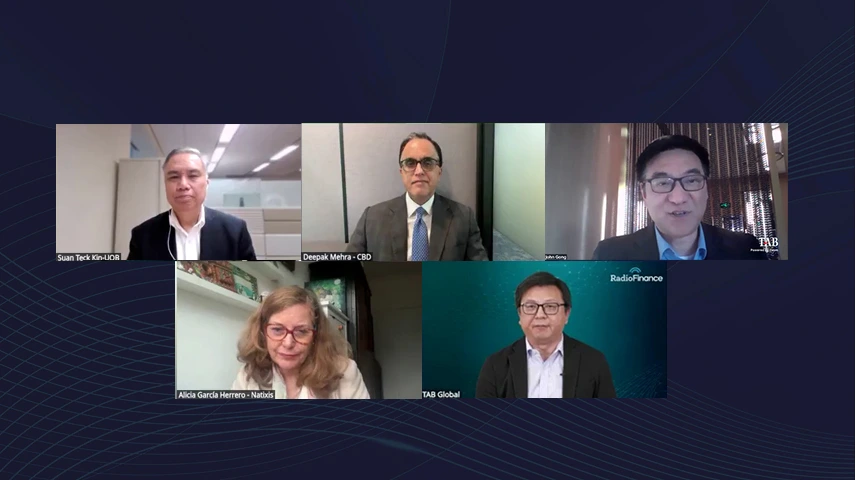
In this RadioFinance session, we bring together global experts to analyse the core forces shaping the financial system in 2026, including structural slowdown, debt overhangs, technological decoupling and the redesign of market infrastructure. The session offers strategic insights for bank leaders navigating a fragmenting world with heightened geopolitical exposure and systemic risk.
Key Discussion Points:
About The Asian Banker RadioFinance
The Asian Banker RadioFinance aims to enhance understanding of the financial services industry globally by bringing together thought leaders, industry experts, practitioners and futurists to examine current, critical issues through a discussion facilitated by visual and web-based platforms. Through the use of interactive technology, participants do not have to take time out from their crowded schedules or leave the comfort of their own desks.

Customers in Malaysia increasingly expect international payments to be as seamless as local transfers. At a closed-door roundtable convened by TAB Global with Visa, participants examined how banks are adapting to these expectations while…

The Japan Banking Innovation Conference 2025, held at The Westin Tokyo, convened over a hundred senior banking executives, fintech leaders, policymakers and technology pioneers to discuss the fundamental shifts redefining financial services.
As the global banking industry braces for a challenging 2025, it faces economic headwinds, geopolitical tensions, trade realignments, and the push for sustainability and technological innovation

The AWS Financial Services Symposium Singapore 2024 showcased how AI, data, and cloud technologies are revolutionising financial services. Industry leaders from AWS and HSBC shared insights into advancing innovation, regulatory responsibility…